OVERVIEW
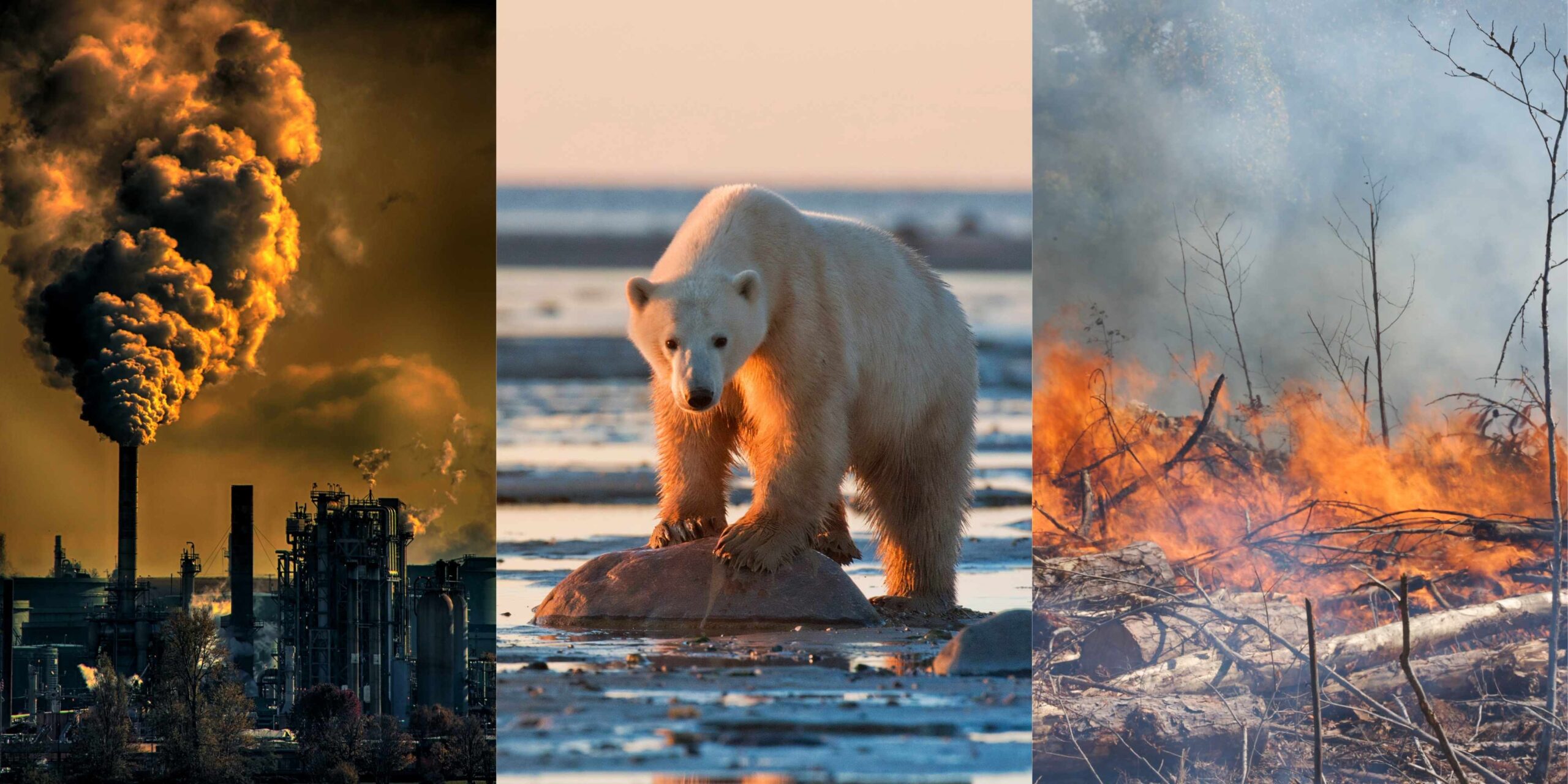
Since life has begun, it has always been dependent on the earth; nature is not made up of one component but multiple components are contrasted together to make the system and structure of earth. These components are interconnected with each other, whether plants or animals, microorganisms or large species, wildlife or ocean life; the tree of nature is complex and the roots are closely related with each other. If there is a default in one component, it adversely affects another component and that is what we are witnessing in the twenty-first century as a climate crisis.
Climate change was properly identified in the mid-nineteenth century and took over a century to investigate and research its causes and effects in detail. It is an abnormality or difference in the climatic cycle that imbalances the weather conditions or negatively impacts the environment. Historically, it has happened from both natural and man-made activities, but from the nineteenth century, the climatic condition of earth started to imbalance rapidly and it has deteriorated more than ever in the twenty-first century and the causes are largely human-driven. The effects of which world is witnessing are in the shape of global warming, global rise in sea temperature, floods, droughts, loss of species, and much more that has never been witnessed in the history of planet. Such effects and events are the direct outcomes of human activities that harmed the system of nature through their misuse of natural resources and negligence towards keeping the environment clean and balanced. And engaging in such activities which are extremely harmful to nature for their short-term benefits which have resulted in the climate emergency that the world is facing right now.
The United Nations (UN) describes climate change as a “change in climate which is attributed directly or indirectly to human activity that alters the composition of the global atmosphere and which is in addition to natural climate variability observed over comparable periods of time”.1
Climate change can also be defined as a change in environmental conditions of the earth that disrupts the mechanism of climate activity and negatively impacts the ecosystem due to abnormal climatic conditions. Historically, climate change first got attention in 1800s as
1 Article 1(2), The United Nations Framework Convention on Climate Change (9 May 1992)
according to UN, it was identified that changes in environmental conditions of earth are caused by human activities.2
A number of not less than 200 science organizations agree on the fact that climate change has occurred and gotten worse due to human activities and negligence towards Earth’s climate mechanism that has caused the climate emergency in the world right now.3 According to the Intergovernmental Panel on Climate Change (IPCC), “since systematic scientific assessments began in the 1970s, the influence of human activity on the warming of the climate system has evolved from theory to established fact.” – Scientific evidence for warming of the climate system is unequivocal.4
As according to the UN, climate change refers to long-term shifts in temperatures and weather patterns.5 There are natural changes in climate activity of earth too due to the solar cycle but since the eighteenth century, it has become evitable that human activities are the main cause behind the abnormal climate activity and rising temperature of the earth. The rising temperature is the result of burning of fossil fuels and greenhouse emissions that produces harmful substances in the atmosphere, thus, resulting in global warming.
THE RISE IN GLOBAL WARMING EQUATES TO THE DESTRUCTION OF A HEALTHY ENVIRONMENT
Global warming is a rise in the overall temperature of the earth caused by greenhouse emissions such as carbon dioxide, methane, and other gases that warms the atmosphere. According to the
2 UN, “What is Climate Change?”, The Science, <https://www.un.org/en/climatechange/what-is-climate-change> 3 Facts & Metrics on Scientific Consensus, “List of Worldwide Scientific Organizations”, Governor’s Office of Planning and Research, State of California, <https://www.opr.ca.gov/facts/list-of-scientific-organizations.html> 4 Arias, P.A., N. Bellouin, E. Coppola, R.G. Jones, G. Krinner, J. Marotzke, V. Naik, M.D. Palmer, G.-K. Plattner,
- Rogelj, M. Rojas, J. Sillmann, T. Storelvmo, P.W. Thorne, B. Trewin, K. Achuta Rao, B. Adhikary, R.P. Allan,
- Armour, G. Bala, R. Barimalala, S. Berger, J.G. Canadell, C. Cassou, A. Cherchi, W. Collins, W.D. Collins,
S.L. Connors, S. Corti, F. Cruz, F.J. Dentener, C. Dereczynski, A. Di Luca, A. Diongue Niang, F.J. Doblas-Reyes,
- Dosio, H. Douville, F. Engelbrecht, V. Eyring, E. Fischer, P. Forster, B. Fox-Kemper, J.S. Fuglestvedt, J.C. Fyfe, N.P. Gillett, L. Goldfarb, I. Gorodetskaya, J.M. Gutierrez, R. Hamdi, E. Hawkins, H.T. Hewitt, P. Hope,
A.S. Islam, C. Jones, D.S. Kaufman, R.E. Kopp, Y. Kosaka, J. Kossin, S. Krakovska, J.-Y. Lee, J. Li, T. Mauritsen, T.K. Maycock, M. Meinshausen, S.-K. Min, P.M.S. Monteiro, T. Ngo-Duc, F. Otto, I. Pinto, A. Pirani, K. Raghavan, R. Ranasinghe, A.C. Ruane, L. Ruiz, J.-B. Sallée, B.H. Samset, S. Sathyendranath,
S.I. Seneviratne, A.A. Sörensson, S. Szopa, I. Takayabu, A.-M. Tréguier, B. van den Hurk, R. Vautard, K. von Schuckmann, S. Zaehle, X. Zhang, and K. Zickfeld, 2021: Technical Summary. In Climate Change 2021: The Physical Science Basis. Contribution of Working Group I to the Sixth Assessment Report of the Intergovernmental Panel on Climate Change [Masson-Delmotte, V., P. Zhai, A. Pirani, S.L. Connors, C. Péan, S. Berger, N. Caud,
- Chen, L. Goldfarb, M.I. Gomis, M. Huang, K. Leitzell, E. Lonnoy, J.B.R. Matthews, T.K. Maycock, T. Waterfield, O. Yelekçi, R. Yu, and B. Zhou (eds.)]. Cambridge University Press, Cambridge, United Kingdom and New York, NY, USA, pp. 33−144: Page 41 and 44
5 UN, Supra N’ 2
UN, 2020 was one of the warmest years on record due to global warming.6 The earth’s temperature has risen at an abnormal rate due to man-made policies which were negligent towards its impact on the climate and were more focused on their short-term benefits such as large-scale deforestation. As they did not consider the outcome of their policies, the earth suffered greatly, weather patterns started to misbalance wildfires and heatwaves became more frequent, and the rapidity of floods and draughts increased.
IPCC is of the view that the “concentration of greenhouse gases in the earth’s atmosphere is directly linked to the average global temperature on Earth”. The main gases that largely contribute to greenhouse emissions and severely deteriorate the environment are carbon dioxide, methane nitrous oxide, and various synthetic chemicals.7
Due to increased industrial waste and discharge of vehicles and machinery, carbon-dioxide and other harmful gases that are not environmentally friendly have been emitted in larger concentrations. According to various UN reports, thousands of scientists and organizations have agreed on the fact the global temperature should not exceed 1.5°C but, as per current conditions, it is expected that global temperature would reach 3.2°C by the end of the century.8 As vehicles other than industries are one of the largest producers of greenhouse gas emissions, all the countries must make pollution control devices in vehicles mandatory in their country. Other than vehicles, industries and manufacturers play a vital role in the emission of harmful gases; countries all over the world must be encouraged to legislate laws that regulate large- scale businesses like industries and manufacturers in a more organic way. Laws should be made for the careful disposal and recycling of industrial wastage mandatory. Usage of modern technologies that helps in the reduction of harmful gases must be made compulsory in industries where the emission rate is high.
RISE IN GLOBAL SEA TEMPERATURE
One of the major outcomes of global warming can be witnessed as the global sea level is arising at an abnormal rate. Oceans absorb 90% of heat from the atmosphere caused by harmful gases, such as carbon-dioxide to keep the atmosphere liveable. But as oceans are not an unlimited
6 UN Climate Change, External Press Release, “2020 was one of three warmest years on record”, Geneva, 14 January 2021, <https://unfccc.int/news/2020-was-one-of-three-warmest-years-on-record>
7 United States Environmental Protection Agency, Report on the Environment, Greenhouse Gases, “What are the trends in greenhouse gas emissions and concentrations and their impacts on human health and the environment?”, Greenhouse Gases and Their Sources, 19 March 2020, <https://www.epa.gov/report-environment/greenhouse- gases>
8 UN, Supra N’ 2, “Every increase in global warming matters”
resource they have limits too, due to an excessive amount of gases in the atmosphere, their absorption by oceans causes the thermal expansion of water. Due to global warming, the ice sheets and glaciers are melting on a disproportionate rate, thus, resulting in the rise in water temperature and severely affects the normal aquatic cycle. According to studies and research, the global sea level has been rising for the past century and the rate has expedient in recent years. In 2014, the global sea level was 2.6 inches and it has risen about one-eight of an inch per year.9 The rise in temperatures comes with a hefty amount of difficulties, particularly, for the residents of coastal areas as well as the whole globe. As the sea temperature rises, storms and tornadoes become more frequent. The IPCC again stated that it is increasingly clear that climate change “has detectably influenced several of the water-related variables that contribute to floods, such as rainfall and snow melts.”10
RAPIDATION IN DROUGHTS
“No country is immune to drought”11 Droughts are one of the biggest hurdles for sustainable development both in under developing countries and in developed countries too. The climate change has also advanced the frequency of droughts due to imbalance weather conditions. A draught can be defined as “a period of abnormally dry weather sufficiently prolonged for the lack of water to cause serious hydrologic imbalance in the affected area.”12 The impact of draught is severe and intense as according to UN, “in the decade to 2017, drought affected at least 1.5 billion people and cost US$125 billion globally. Forecasts estimate that by 2050 droughts may affect over three-quarters of the world’s population”.13
“An estimated 55 million people globally are directly affected by droughts every year.”14
By looking at the above statement, one can have the idea of the extent of disasters led by droughts. Due to global warming and warmer temperatures across the regions, the evaporation increases leaving surface water dry which consequently leads to desertification. Droughts are caused by various reasons; natural and human actions.
9 National Oceanic and Atmospheric Administration United States Department of Commerce, Ocean Facts, Sea Level, “Is sea level rising?”; see also National Geographic Society, “Sea Level Rise”, 19 May 2022
10 Melissa Denchak, “Flooding and Climate Change: Everything You Need to Know”, Climate Change and Flooding, Natural Resources Defense Council, 10 April 2019
11 Ibrahim Thiaw, Executive Secretary of the United Nations Convention to Combat Desertification (UNCCD), UN Report, May 11, 2022
12 R.E. Huschke, American Meteorological Society, Glossary of Meteorology (1959)
13 UNCCD, Land & Life Drought, “Overview” <https://www.unccd.int/land-and-life/drought/overview>
14 UNCCD, Drought in Numbers: Restoration for Readiness and Resilience, Official Report, 11 May 2022
But due to climate change, disproportionate weather cycles and global warming it has been increasing rapidly forcing people to leave their habitat and move to different places. This is one of the main disadvantages of drought as it puts the lives and security of people in danger. It is not an easy task to leave your habitat and move to a different place as it opens a plethora of more difficulties. Not only it just risks the life and food security of drought migrants but also pushes them into poverty and difficulty in accessing the basic necessities of life such as housing, employment, food, and education.
LOSS OF SPECIES EQUATES TO LOSS OF BIODIVERSITY
To understand how the loss in species has become more rapid, the fact that should be kept in mind is that nature is diverse with millions of species of plants, animals, bacteria, fungi, micrograms, etc. This biodiversity is important for the systemic flow of nature not just for the environment but for the humans themselves.
According to United Nations Environment Programme (UNEP), “Biological diversity or biodiversity is the variety of life on Earth and the natural patterns it forms.”15 It is a cycle created by nature that includes the smallest of species to the largest essential for the existence of each other. But the human-driven activities have led to a danger of around one million species extinction. 16 Due to climate change, desertification, and deforestation millions of species are at risk of extinction and many have extricated due to these causes. Because of deforestation millions of species are forced to change their habitat and as global warming has increased wildfires are more frequent resulting in the loss of many species who are dependent on forests. Climate change has more severely risked the lives of species that live in a certain environment and has endangered their survival. Another report states the view that Biodiversity is declining globally at rates “unprecedented in human history” and the rate of species extinctions is accelerating, with “grave impacts on people around the world now likely”,17 it is crucial to keep life thriving on planet earth. The ecosystem is connected and living things are dependent on each other, such effects are posing a serious threat to the sustainability of the environment. “Ecosystems, species, wild populations, local varieties and breeds of domesticated plants and animals are shrinking, deteriorating or vanishing. The essential,
15 UNEP, UNEP and Biodiversity, also published in 75th Session of UN General Assembly, September 2020,
<https://www.unep.org/pt-br/node/28198>
16 European Commission, “Global Assessment Report on Biodiversity and Ecosystem services of the Intergovernmental Science-Policy Platform on Biodiversity and Ecosystem Services” (2019)
17 UN Report: Nature’s Dangerous Decline “Unprecedented”; Species Extinction Rates ‘Accelerating’, Paris, 6 May 2019
interconnected web of life on Earth is getting smaller and increasingly frayed… This loss is a direct result of human activity and constitutes a direct threat to human well-being in all regions of the world.”18 One of the main reasons for the loss of species is the excessive hunting of wild and endangered animals. Their hunting should be prohibited and strict actions must be taken and heavy penalty should be imposed on people who hunt these animals especially endangered species. There should be a wildlife management department in each country to regulate these policies and protect the wildlife and endangered species.
DEFORESTATION LEADING TO A MORE HAZARDOUS CLIMATE CRISIS
Deforestation, a major threat to biodiversity and the leading cause of climate change and global warming is a phenomenon that has happened at an alarming rate since humans have started clearing out forests land excessively for their own benefit. Deforestation is the conversion of forests for other land uses (regardless of whether it is human-induced).19 Deforestation in today’s world is directly driven by human actions. As the world has been witnessing the outcomes of climate change in the shape of global warming, loss of species, global rising temperature, storms, floods, and droughts, deforestation is the last kneel in the coffin for the total destruction of earth’s environment.
Life cannot survive on the earth without forests, they are the largest producers of oxygen, maintains the temperature of earth suitable and keep the atmosphere clean by absorbing carbon dioxide and other harmful gas emissions which prevents global warming and rising sea temperature. They keep the atmosphere balanced and biodiversity secure but the acceleration in deforestation has posed a serious risk to millions of plants and species that are dependent on forests. The report called for transformative changes to restore and protect nature, found that the health of ecosystems on which we and all other species depend is deteriorating more rapidly than ever, affecting the very foundations of our economies, livelihoods, food security, health, and quality of life worldwide.20 “Forests are home to more than three-quarters of the world’s life on land. Approximately 750 million people, including 60 million Indigenous people, live in forests, too.”21
18 UN Report, Prof. Settele, Ibid
19 Food & Agriculture Organization of the United Nations, Global Forest Resources Assessment, Key Findings, Rome, 2020 <https://www.fao.org/documents/card/en/c/ca8753en>
20 2019 Report, Supra N’ 16
21 World Wide Fund for Nature Inc., Initiatives Overview <https://www.worldwildlife.org/initiatives/forests>
Biodiversity includes not just trees but also species of various plants and animals that makes up the whole system contributing to the systematic environment of earth. As “since 1990, 420 million hectares of forest have been lost through conversion to other land uses”22 known as the lungs of the earth, the amazon rain forest is one of the largest absorbers of harmful gases trapped in the atmosphere that increases the global warming. As per data, around 17% of the amazon rainforest has been lost through deforestation and it is disappearing faster than ever witnessed in earth’s history. As it is said that “We cannot protect the Earth’s biodiversity without protecting our forests. They harbour most of the world’s terrestrial biodiversity and support food security, jobs, and livelihoods for millions of people. Conservation, restoration and sustainable use are key to curbing deforestation and protecting the world’s forests into the future.”23
There should be a large-scale awareness drive all over the globe about the hazardous effects of deforestation and each country should start a large-scale project of plantation of trees in their country by their environment ministry or respective department. Unplanned Urbanization must be banned so the forest land may not be used for commercial purposes. The area for forest land must be determined in each country and should be protected by the government. Trees are largely cut for the making of furniture and crockeries, by using alternative manufacturing of furniture and crockeries through recycled stuff can help reduce the usage of wood on a massive scale.
POLLUTION AS THE LARGEST CONTRIBUTOR TO CLIMATE CHANGE
Pollution is the presence of harmful substances that contaminates the environment. Today, it’s majorly human-driven. And its effects can be assessed in the form of its types. Air pollution occurs when harmful substances are released which pollute the air and negatively impact the environment in the form of global warming as well as health. According to UNEP, air pollution kills an estimated 7 million people each year and is the biggest environmental risk of our time.
Apart from air pollution, soil pollution is also a major contributor to climate change. Soil pollution is the contamination of soil by harmful chemicals such as CO2 and solid and liquid waste that is directly dumped on the soil. The dumping of trash and other wastage destroys the
22 Food & Agriculture Organization of the United Nations, Report on The State of the World’s Forests, “Status and Trends in Forest Area”, 2020
23 UNEP-WCMC, Senior Programme Officer of the Climate Change & Biodiversity in “Earth’s Biodiversity Depends on the World’s Forests”, May 2020, <https://www.unep-wcmc.org/en/news/earths-biodiversity- depends-on-the-worlds-forests>
fertility of soil as well as results in biodiversity loss due to soil erosion and hazardous substances present in the soil. Facts speak that “land degradation is a major contributor to climate change and climate is foreseen as a leading driver of biodiversity loss.”24
Land pollution caused by unsustainable use of soil, contamination of soil through chemical substances, dumping wastage directly on to soil, unplanned Urbanization, and the usage of excessive pesticides and toxins to keep bacteria and insects away from crops also paves way for water pollution.
As Water pollution occurs when land wastage is directly thrown into seas and oceans which not only just pollutes the water but also poses a serious risk to the healthy survival of water species. Around 700 species are known to have been affected by plastic pollution “Every year, about 8 million tons of plastic waste escapes into the oceans from coastal nations. That’s the equivalent of setting five garbage bags full of trash on every foot of coastline around the world.”25
NOTABLE INTERNATIONAL AGREEMENTS AND CONVENTIONS BY UNITED NATIONS TO DEAL WITH THE CLIMATE CRISIS
The UNFCCC is a notable step to combat the climate crisis, it came into force on 21 March, 1994 with currently 198 members being the party. According to UN, the “ultimate objective of all three agreements under the UNFCCC is to stabilize greenhouse gas concentrations in the atmosphere at a level that will prevent dangerous human interference with the climate system, in a time frame which allows ecosystems to adapt naturally and enables sustainable development.”26
This convention laid the foundation of the historical Paris agreement which is a legally binding international treaty that gathered all the countries to unite on one platform to take significant measures for the betterment of climate. It came into force on 4 November 2016 with a motive to keep the global temperature below 2° and to make and implement such policies that are in favor of environment. Pakistan ratified this convention in June, 1994 and since then Pakistan
24 Stockholm Environment Institute, “Land Degradation worsening climate change and undermining well-being of billions”, Key Facts & Figures, 26 March 2018, at para 4
25 Laura Parker, National Geographic, “The World’s Plastic Pollution Crisis Explained”, 19 May 2022.
26 About the Secretariat <https://unfccc.int/about-us/about-the-secretariat>
has taken significant measures to combat the climate crisis such as the “billion trees tsunami”, a plantation drive that restores 350,000 hectares of degraded land. Pakistan has been a signatory to various international agreements committed to improving the climatic condition and has been an active participant on an international level to combat the crisis.
CONCLUSION
From the above-discussed effects and causes of climate change, one can understand that we are currently in a serious climate crisis that needs the full attention of people across the globe. The issue has gotten out of hand and we need effective and efficient policies to combat the crisis and humble climate disasters. Countries all over the world must take an action now as the situation demands strict actions and efficient policies. The countries that are party to UNFCCC must implement its mandate in their countries and reduce greenhouse gas emissions, protect forests, improves the quality of soil by making policies to ban the use of harmful substances like pesticides in soil, ban the hunting of endangered and wild animals and use the natural resources adequately to maintain their long-term sustainability and improves the condition of environment.